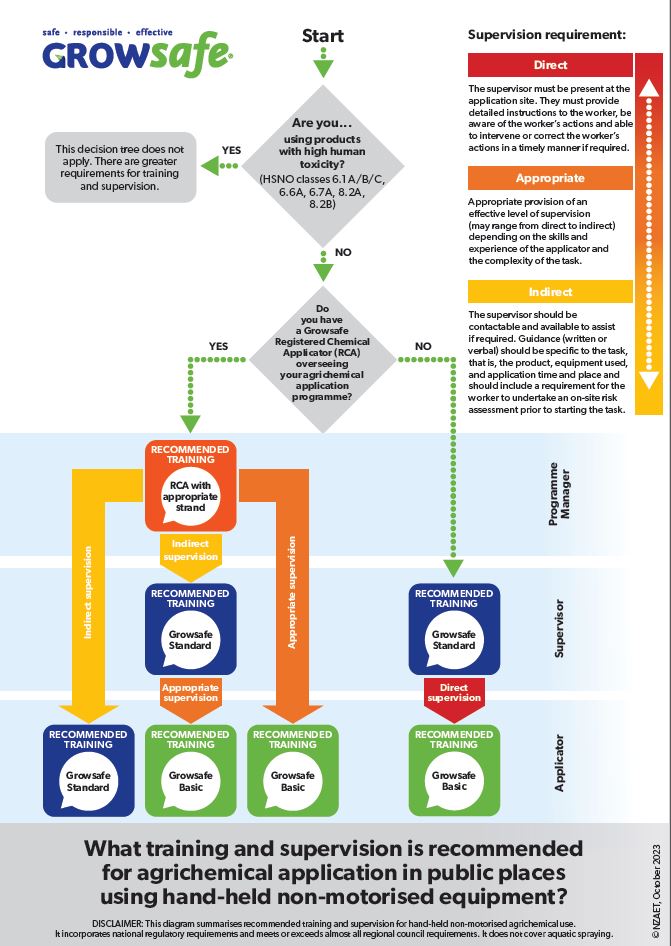
I'm only doing non-motorised handheld application of agrichemicals. What training and supervision do I need?
Definition of low risk application
This page covers low risk application using handheld application equipment such as non-motorised backpacks, weed-wiper, cut and paste application of agrichemicals. Many people are using these techniques in public places such as regional parks or the conservation estate.
Note: this decision tree does not apply to the following situations which require a higher level of training and/or supervision:
- aquatic application (ie control of aquatic pest plants)
- products with high human toxicity
- Acute toxicity category 1, 2 or 3 (HSNO classes 6.1 A,B or C)
- Germ cell mutagenicity category 1 (HSNO class 6.6A)
- Carcinogenicity category 1 (HSNO class 6.7A)
- Skin corrosion category 1 or 2 (HSNO class 8.2A or B).
The rules can be quite complicated but our decision tree for handheld application will help you identify the appropriate level of training and supervision for you and your staff. This decision tree incorporates any requirements of the Environmental Protection Authority and WorkSafe for training and/or certification for this type of application. It also meets or exceeds the regional plan requirements for almost all regions.*
The recommended training and supervision makes a distinction between organisations whose agrichemical programme is managed by a Growsafe Registered Chemical Applicator (RCA) and those who are not. This reflects the level of knowledge and experience of RCAs and their ability to develop and implement risk-management procedures for others in their organisation to follow. No distinction is made between contractors and non-contractors - instead the risk profile is based on application in a public place.
Supervision
It is important to read and understand the definitions of supervision:
- Direct supervision: The supervisor must be present at the application site. They must provide detailed instructions to the worker, be aware of the worker's actions and able to intervene or correct the worker's actions in a timely manner if required.
- Indirect supervision: The supervisor should be contactable and available to assist if required. Guidance (written or verbal) should be specific to the task, that is, the product, equipment use, and application time and place, and should include a requirement for the worker to undertake an on-site risk assessment prior to starting the task.
There is also an option for '
Appropriate supervision'. This will be specific to a person and a task and is likely to vary over time from Direct supervision for a new worker to Indirect supervision for an individual with experience of the application task at a known site. The supervisor should be able to identify the level of supervision provided and be able to justify the decision on the level of supervision.
* Tasman and Taranki both require direct supervision of all contractors by an RCA, and Taranaki also requires all non-contractor applicators to hold the equivalent of a Growsafe Standard (as at 2023).