Guidance
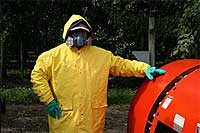 Wear appropriate personal protective equipment.
The agrichemical product's label will give you information about the minimum PPE required for its safe application. Additional information can be found on the product's Safety Data Sheet (SDS). Where more than one agrichemical is being mixed or applied, the protective clothing applicable to the most hazardous agrichemical should be worn.
Remember that the concentrated chemical is the most hazardous so you may wish to wear additional PPE during mixing.
Commonly used PPE in agrichemical spraying include:
- Protective spray suit/apron: Unless working above shoulder height, always wear your spray suit outside your gloves and boots. For mixing agrichemicals, an impermeable apron may be appropriate. Put protective clothing on before mixing and spraying, and while cleaning up equipment.
- Gloves: Nitrile gloves are the most versatile for handling agrichemicals. PVC gloves are also adequate. Never wear rubber products when handling horticultural pesticides because they can react with some substances and dissolve.
- Eye/face protection: Goggles or a face shield may be appropriate. Wear safety glasses, goggles or a face shield when mixing pesticides and whenever there is a possibility of spray drift. Spraying while wearing soft contact lenses is not advised.
- Respirators: A face mask should be adjusted to fit comfortably over your nose and mouth so that any air you breathe in must only be drawn through the filter (and not around the edges of the mask). Make sure you choose the right respirator, especially its filter (filter cartridges suitable for agrichemical use will have a brown band). Replace filters after about 6 months - irrespective of the amount of time they have been used - or immediately if you start tasting or smelling the fumes or have difficulty breathing while using the mask.
Remember that PPE is used to minimise the exposure to hazards - but is not a solution for controlling hazards by elimination or isolation.
The HSW Act has specific requirements regarding PPE including that:
- the employer must provide safety equipment and clothing free of charge, and ensure that it is accessible and used
- information regarding the protection and correct use of the PPE should be provided
- the employer provides training in the use, maintenance, cleaning, storing and inspection of the PPE and damaged PPE must be replaced immediately
- employees also have a responsibility for their own safety.
The Worksafe NZ website provides more details surrounding these requirements from an employer's point of view.
Cleanup after spraying:
- Don't wear the protective clothing for any longer than is necessary.
- Non-waterproof cotton overalls should be removed and machine-washed separately from other clothes.
- Waterproof suits should be rinsed off with clean water before removal and machine wash separately.
- Rinse gloves in clean water before removing them, then wash them with warm, soapy water.
- Store all PPE in a dry and clean place outside the agrichemical store.
- Take a cool shower (hot water opens the skin's pores) and put on clean clothes.
Respirators:
- Clean your respirator after use. Remove the filter cartridge(s) before washing the respirator in warm, soapy water. Dry the respirator and store it in a sealed container.
- Store filters in an airtight container when not being used. Do not store them in your agrichemical store.
The re-entry interval (REI) (or re-entry period) is the minimum amount of time that must pass between the time the agrichemical was applied to an area or crop and the time that people can go into that area without protective clothing and equipment.
Re-entry times are set to protect people against poisoning by agrichemicals if they enter a treated area too soon after application without proper protective equipment. If there is no re-entry time specified on the label, recommended practice is to wait until spray has dried.
Unfortunately, it is relatively easy to be exposed to agrichemicals after they have been applied to their target. For example:
- Breathing in vapours, dusts or mists
- Touching residues on the sprayed plants
- Getting the agrichemical in your eye through vapours, dusts or mists, or by rubbing your eyes with your hand, a glove or clothing that is contaminated with residue
- Eating food that has been treated or eating without first washing hands
When treated plants are touched during work activities such as weeding, thinning, or brushing against plants, some agrichemical residue may be transferred to skin. Workers in a field can also cause residues on plants and on the soil surface to 'fly up' as a dust - the dust settles on the worker's skin and/or are inhaled. People in treated areas may also breathe fumes (vapours) from a recent agrichemical application.
Signage should be used to advise on re-entry restrictions.